The Complete Guide to On-Demand Interpretation Services: How AI Is Replacing $200/hr Human Interpreters for Conferences, Churches, and Live Events
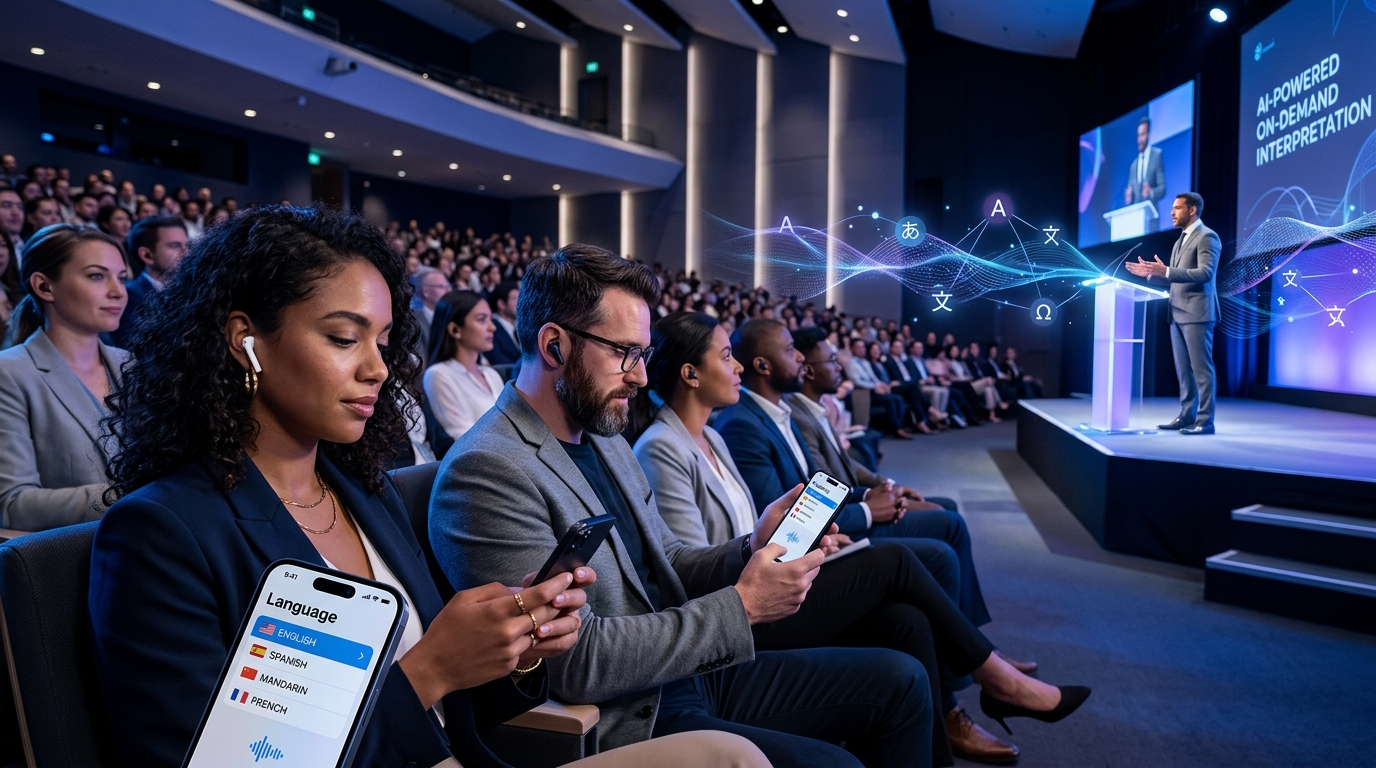
If you have ever organized a conference, a multi-service church gathering, or a hybrid corporate event, you know the drill. Weeks before the event, you start hunting for interpreters. You negotiate rates, confirm availability, and hope nobody cancels. You pay for a minimum block of hours, even if you only need 45 minutes of actual interpretation. Then comes the hardware rental: headsets, receivers, transmission booths, and the technician who sets it all up. By the time the first keynote hits the stage, you have spent thousands of dollars to cover two or three languages. That model is collapsing under its own weight. A new category of on-demand interpretation services, powered by AI, is rewriting the economics and logistics of live event translation. This guide explains exactly how that shift works, what it means for your events, and why the $200-per-hour human interpreter is no longer the default choice.
What Are On-Demand Interpretation Services? (And Why They’re Replacing Scheduled Bookings)
On-demand interpretation services give you instant access to an interpreter without advance scheduling. Instead of booking a specific person days or weeks ahead, you open an app, scan a QR code, or click a link, and interpretation begins immediately. The interpreter can be a human professional connecting via video or phone, or it can be an AI engine translating speech in real time. Both models fall under the on-demand umbrella, but they differ dramatically in speed, cost, and scale.
The traditional model works like this: you contact an agency, specify your language pair, confirm a date, and pay for a minimum block of time. A certified human interpreter might charge $200 per hour with a three-hour minimum, meaning you pay $600 even if your session runs 90 minutes. If you need three languages, you multiply that cost by three. If an interpreter gets sick or stuck in traffic, your event has a gap.
On-demand services flip that script. Human-on-demand providers maintain networks of thousands of interpreters who can join a call in 13 to 20 seconds. That is fast, but it still depends on human availability. If 50 event attendees suddenly need Haitian Creole at the same moment, a human network can strain under the load. AI-powered on-demand interpretation services, like Exbabel, remove that bottleneck entirely. There is no waiting for a human to become available. The AI engine is always on, handles unlimited concurrent users, and supports 180-plus languages from the same interface. For event organizers, that difference is existential: you stop managing interpreter logistics and start managing attendee experience.
Simultaneous vs. Consecutive Interpretation: Which One Does Your Event Need?
Interpretation comes in two fundamental modes, and knowing which one your event requires determines everything from technology choices to audience engagement.
Simultaneous Interpretation (The Conference Standard)
Simultaneous interpretation happens in real time while the speaker is still talking. The interpreter, whether human or AI, translates continuously with only a few seconds of lag. The audience listens through headsets or, in modern setups, through their own smartphones and earbuds. This mode is the standard for large conferences, keynote speeches, multi-language worship services, and any setting where pausing the speaker would disrupt the flow.
For decades, simultaneous interpretation required soundproof booths, specialized headsets, and an on-site technical crew. Exbabel’s AI approach eliminates all of that. The same AI engine processes the speaker’s audio stream and delivers translated audio to each listener’s device in near real time. No booth, no hardware, no technician. The audience simply scans a QR code and selects their language.
Consecutive Interpretation (The Small Group Standard)
Consecutive interpretation works differently. The speaker says a sentence or two, then pauses while the interpreter translates. This back-and-forth rhythm suits one-on-one meetings, Q&A sessions, legal depositions, and small group discussions where precision matters more than speed. It doubles the time needed for any given exchange, but it allows for clarification and nuance.
One underappreciated advantage of AI-powered on-demand interpretation services is that the same system can switch between simultaneous and consecutive modes instantly. A human interpreter typically specializes in one mode. If your conference keynote needs simultaneous interpretation but a breakout Q&A needs consecutive, you would traditionally hire two different professionals. AI handles both modes from the same engine, adapting to the format without additional cost or scheduling complexity.
The Shift from On-Site Human Interpreters to Virtual AI Interpretation
The old reality of event interpretation was a logistical puzzle. You flew interpreters in, booked hotel rooms, paid per diems, and rented equipment that cost more than the interpreters themselves. A two-day conference with two language pairs could easily run $3,000 to $5,000 before you even accounted for the technician who babysat the transmission equipment. If an interpreter called in sick, you scrambled. If an unexpected attendee arrived speaking a language you had not planned for, you apologized and moved on.
The new reality is a single QR code displayed on a screen or printed on a program. Attendees point their phone cameras at it, tap a link, and choose from a list of available languages. They listen through their own earbuds. There is no hardware to rent, no dongles to distribute, no FM transmitters to configure. Exbabel’s platform requires no app download, no account creation, and no special equipment. That alone removes the single biggest friction point in event interpretation: the moment when half your audience cannot figure out how to tune in.
The hybrid event advantage compounds this shift. When your conference has both in-room and remote attendees, traditional interpretation forces you to run two parallel systems: one for the physical headsets in the room and one for the streaming feed. AI on-demand interpretation unifies both audiences under the same QR code or link. A remote attendee in São Paulo gets the same Portuguese interpretation as the person sitting in the third row in Chicago. The technology does not care where the listener is located, only that they have a smartphone and an internet connection.
Conference Interpretation Services: What Organizers Need to Know in 2026
If you are planning a conference this year, the interpretation conversation has changed. The questions you ask vendors should be different than they were even two years ago.
Scalability is the number one concern that most organizers do not realize they have until it is too late. A human interpreter can handle one language pair per session. If your conference has three concurrent breakout tracks and you need Spanish, Mandarin, and Arabic across all three, you need nine interpreters working simultaneously. That is expensive and logistically fragile. AI handles unlimited concurrent languages across unlimited concurrent sessions. The same Exbabel subscription covers every track, every room, and every attendee.
Setup time is another hidden cost. Traditional interpretation requires a tech rehearsal two to four hours before doors open. With AI on-demand interpretation, setup takes under five minutes. You generate a QR code from the dashboard, project it on the screen or print it in the program, and you are done.
The audience experience matters just as much. Attendees do not want to download yet another app, create yet another account, and remember yet another password. Exbabel’s QR-code join works from any smartphone browser. The attendee scans, taps, selects a language, and listens. No friction, no support tickets, no frustrated people walking up to the registration desk asking for help.
Cost is the comparison that makes the decision obvious. Human interpreters charge $200 to $400 per hour per language pair, often with minimums. A single day of two-language interpretation at a conference can cost $3,200 to $6,400. Exbabel’s Starter plan begins at $39 per month and supports 180+ language groups. Even accounting for the fact that AI is not yet the right tool for every scenario, the cost differential for conference-scale events is not a percentage improvement. It is an order-of-magnitude shift.
Finally, there is the problem of the unexpected attendee. A last-minute registration from Japan, Brazil, or Saudi Arabia used to mean an awkward apology. With 180-plus languages always available, that panic disappears. You serve every attendee, every time, without scrambling to find a last-minute interpreter who may or may not be available.
AI Interpretation vs. Human Interpreters: An Honest Comparison
The industry conversation often frames this as a binary choice: AI versus humans, with one side destined to win. The reality is more nuanced. Both have strengths, and the right choice depends on the context.
Human interpreters bring deep cultural understanding and the ability to navigate ambiguity. In a sensitive medical consultation where a patient is receiving a difficult diagnosis, a certified human interpreter reads body language, adjusts tone, and catches subtle meaning that AI might miss. In a courtroom, where a single mistranslated word can alter the outcome of a case, the stakes justify the cost. For those high-stakes, high-nuance environments, human interpreters remain the gold standard.
For the other 95 percent of events, the comparison tilts decisively toward AI. A conference keynote does not require the same level of contextual nuance as a deposition. A church sermon translated into six languages for congregants listening on their phones does not carry the same liability as a medical consent form discussion. In these settings, AI delivers accuracy rates above 95 percent at roughly one percent of the cost.
| Factor | Human Interpreter | AI (Exbabel) |
|---|---|---|
| Hardware Required | Booths, headsets, receivers, technician | Smartphone the attendee already owns |
| Cost | $200–$400+/hr per language | $39/mo Starter plan + $10/hr per language |
| Languages | 1–2 per interpreter | 180+ simultaneously |
| Availability | Advance booking with minimums | Instant, 24/7, no scheduling |
| Setup Time | 2–4 hour tech rehearsal | Under 5 minutes |
| Scalability | One pair per interpreter | Unlimited concurrent languages and sessions |
| Hybrid Support | Separate in-room and streaming systems | Single QR code serves all audiences |
| Cultural Nuance | Excellent for high-stakes settings | Improving rapidly; ideal for events and worship |
Exbabel’s position in this landscape is clear. We are not trying to replace the certified medical interpreter in the oncology ward or the court-certified interpreter in the federal courtroom. We are the modern alternative for conferences, churches, webinars, and live events where the old model was always overkill. For those events, paying $200 per hour per language was never a good deal. It was simply the only deal available. That has changed.
Real Use Cases: Where On-Demand AI Interpretation Shines
The abstract promise of AI interpretation becomes concrete when you see it in specific settings. These are the environments where the technology is already transforming how organizations serve multilingual audiences.
Churches and Religious Services
Multilingual congregations have traditionally faced a hard choice: run separate services in each language, or invest in expensive interpretation equipment that requires volunteers or paid interpreters to operate. Separate services fragment the community. Equipment-based interpretation limits how many languages you can support and requires ongoing maintenance.
AI on-demand interpretation changes the calculus. A single English-language service can be translated live into Spanish, Mandarin, Korean, Tagalog, or any other language represented in the congregation. Attendees scan a QR code printed in the bulletin or projected on a screen, select their language, and listen through their own earbuds. There is no hardware installed in the sanctuary, no volunteer schedule to manage, and no limit on the number of languages offered. The same service that once served only English speakers now serves everyone, simultaneously, without adding a minute to the runtime or a dollar to the weekly budget beyond the subscription cost.
Multi-Track Conferences
Large conferences with concurrent breakout sessions create a multiplication problem for interpretation. If four rooms are running sessions simultaneously and each needs two languages, you need eight interpreters working at the same time. Scheduling that many qualified professionals is difficult. Paying them all is expensive. And if one cancels, you have a hole in your program.
AI interpretation handles all tracks simultaneously from the same platform. Each room displays its own QR code, or a single code serves the entire event with language selection determining which audio stream the attendee receives. The organizer does not assign interpreters to specific rooms or worry about coverage gaps. The AI engine scales across every session without additional cost or complexity.
Hybrid and Virtual Events
The pandemic accelerated the shift to hybrid events, but interpretation technology lagged behind. Remote attendees were often left out entirely, watching a stream in the original language while in-person attendees enjoyed interpretation through headsets. Bridging that gap required complex audio routing that few production teams could manage reliably.
AI interpretation integrates with the platforms organizations already use: Zoom, Microsoft Teams, YouTube Live, and custom web platforms. The same QR code or link serves both in-person and remote audiences. A remote attendee in Berlin gets the same German interpretation as the person sitting in the conference hall in Atlanta. The technology treats all listeners equally, regardless of location.
Webinars and Town Halls
Global companies running internal town halls or public webinars face a version of the conference problem at smaller scale. The CEO presents in English, but the workforce spans 15 countries. Hiring 10 human interpreters for a 45-minute webinar is cost-prohibitive. Running the webinar in English only excludes a significant portion of the audience and undermines the inclusive culture the company claims to value.
With AI on-demand interpretation, a single subscription covers every language the workforce needs. The presentation is translated live into 10, 15, or 20 languages simultaneously. Employees choose their language from a dropdown and listen on their own devices. The cost does not scale with the number of languages or the number of listeners. That is a fundamentally different economic model than human interpretation, and it makes global inclusion achievable for events of any size.
How to Evaluate On-Demand Interpretation Service Providers (Checklist)
Choosing a provider requires looking past marketing claims and examining the factors that determine whether the service will actually work for your events.
- Language coverage is the first filter. Does the provider offer 180-plus languages, or are they limited to the most common two or three? A provider that covers only Spanish, Mandarin, and French cannot serve the attendee who needs Vietnamese, Swahili, or Ukrainian. Exbabel’s 180-plus language library means you never turn someone away because their language is not supported.
- Hardware requirements are the second filter. Does the provider require you to buy or rent equipment? If the answer is yes, factor that cost and logistical burden into your comparison. Exbabel requires no hardware. Attendees use their own smartphones and earbuds.
- Ease of access determines adoption rates. If attendees must download an app, create an account, verify an email, and navigate a multi-step setup process, a significant percentage will give up before they ever hear a translation. QR-code join eliminates that friction. Scan, tap, listen. Three steps, no accounts, no downloads.
- Pricing model transparency separates honest vendors from those hiding costs. Per-minute fees ranging from $1.25 to $4.00 add up fast when you have hundreds of attendees listening for hours. Flat monthly subscriptions like Exbabel’s $39 Starter plan make costs predictable and remove the incentive to limit interpretation to save money.
- Latency affects the audience experience. Translation should appear in near real time, with less than two seconds of lag. Anything longer creates a disjointed experience where the audience hears the original speaker and the translation out of sync.
- Trial availability lets you test before committing. Exbabel offers a 30-day free trial so you can run a real event or a rehearsal and evaluate the experience firsthand. A provider that does not offer a trial is asking you to buy on faith.
- Compliance requirements vary by industry. Healthcare events may require HIPAA compliance. Legal events may require specific certifications. For most conferences, churches, and corporate webinars, these certifications are less critical than cost, coverage, and ease of use. Match the compliance level to your actual needs rather than overpaying for certifications your event does not require.
Why 180+ Language Support Matters (vs. Traditional 2–3 Language Interpreters)
The difference between supporting two languages and supporting 180 is not just a bigger number on a spec sheet. It changes who can attend your events and what kind of organization you can be.
A traditional human interpreter covers one or two language pairs. If you hire a Spanish interpreter, you get Spanish. If you also need Mandarin, you hire a second person. If you need Arabic, a third. Each additional language adds cost, scheduling complexity, and a potential point of failure. Most events cap interpretation at two or three languages because going beyond that is simply not practical.
AI on-demand interpretation services that support 180-plus languages invert that logic. Adding a language costs nothing and requires no additional staffing. A global tech conference with attendees from 40 countries can serve all 40 languages, not just the top three. A church in a diverse urban neighborhood can serve every language group in the congregation, not just the two largest. A corporate town hall can include every office worldwide, not just the ones in countries where the company could justify hiring interpreters.
The cost of not covering a language is invisible but real. When an attendee cannot understand the content, they disengage. They check email, scroll social media, or leave. They feel excluded, and they remember that feeling when deciding whether to attend next year. For churches, language exclusion can mean families leaving for a congregation that speaks their language. For conferences, it can mean lost registrations and diminished reputation. For companies, it can mean employees who feel like second-class citizens in their own organization.
Exbabel’s 180-plus language support is not a marketing bullet point. It is the feature that makes on-demand AI interpretation viable for truly global events. When every language is always available, you stop thinking about interpretation as a scarce resource to be rationed and start thinking about it as a utility, like Wi-Fi or electricity, that is simply there for everyone.
Conclusion: The Future of Event Interpretation Is On-Demand and AI-Powered
The $200-per-hour human interpreter model served its purpose for decades, but it was always a compromise. It was expensive, logistically heavy, and limited in reach. Most events could only afford two or three languages, leaving everyone else to fend for themselves. The rise of AI-powered on-demand interpretation services changes the equation entirely. For the cost of a single human interpreter’s minimum booking, you can cover 180-plus languages for an entire month of events. No hardware, no scheduling, no minimums, and no attendee left out.
Exbabel is built for this moment. Our platform delivers instant AI interpretation through a QR code that works on any smartphone. The Starter plan begins at $39 per month. The language library spans 180-plus languages. And you can test the entire experience with a 30-day free trial before you commit to anything. The modern alternative to expensive, hardware-dependent human interpretation is here. Stop paying for minimums you do not need. Stop renting equipment your attendees struggle to use. Start your free trial and see what on-demand AI interpretation can do for your next event.
Explore how live video translation works on the Exbabel platform, or see the global impact of accessible interpretation at scale.
Related Resources
How Exbabel Works
See the 5-step setup process for real-time AI translation.
Latency Benchmark Report
Independent performance evaluation conducted under IEEE 829 and ISO 25010 guidelines.
Exbabel Live
Real-time live video translation with AI voiceovers and synchronized captions.
Schedule a Demo
Talk to our team about your interpretation needs.